

Last updated on December 18th, 2025 at 04:29 pm
Why Custom Screw Conveyors Matter for Your Operation
A custom screw conveyor is a bulk material handling system specifically engineered to match your unique material properties, facility layout, and production requirements—rather than adapting your process to fit a standard, off-the-shelf design.
Quick Answer: When to Choose a Custom Screw Conveyor
- Unique Materials: Your material is sticky, abrasive, friable, high-temperature, or corrosive.
- Space Constraints: You need vertical routing, tight angles, or integration into limited floor space.
- Specific Performance: Standard capacities, discharge points, or flight designs don’t meet your needs.
- Sanitary Requirements: Food, pharmaceutical, or chemical applications demand special materials or finishes.
- Integration Needs: The conveyor must connect seamlessly with existing processing equipment.
If you’re dealing with difficult materials or unique facility constraints, you’ve likely encountered the limitations of standard equipment: premature wear, material fallback, and downtime that stops your entire line. These problems signal that your process needs more than a standard solution.
Since 1932, S. Howes has been designing bulk material handling equipment. Today’s custom screw conveyors can handle everything from large pellets to sub-micron powders, with systems ranging from 4″ to 60″ in diameter and lengths of 50 feet or more. The key difference isn’t just size—it’s engineering that matches your specific challenge.
Properly engineered custom screw conveyors deliver measurable benefits: reduced maintenance, increased throughput, and improved safety. They outperform standard alternatives by eliminating bottlenecks, minimizing energy use, and extending service life.
This guide covers when customization is necessary, how material properties influence design, what the engineering process involves, and how to plan for integration, costs, and lead times.
Why Go Custom? The Best Benefits of Custom Screw Conveyors
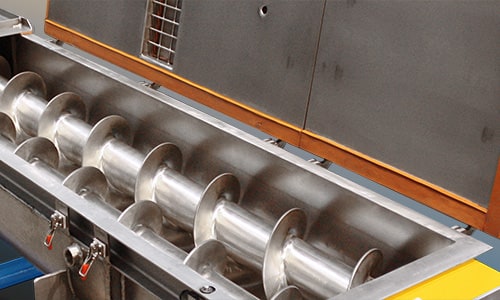
After decades of designing custom screw conveyors, we’ve learned the right equipment doesn’t just move material—it transforms your entire operation. While standard conveyors force your process to adapt to the equipment, a custom solution adapts the equipment to your process. This shift makes all the difference.
The benefits are measurable: improved safety from purpose-built guards, increased throughput by eliminating bottlenecks, and reduced downtime by engineering out problems before they start. Perhaps most importantly, a custom system delivers long-term ROI. While the upfront cost is higher, the savings in maintenance, energy, and extended equipment life tell a different story. We’ve built equipment that’s still running strong after 75 years—a testament to engineering machinery for its actual job.
Optimal material handling means your conveyor treats your product exactly as needed. Fragile materials stay intact, sticky substances keep moving, and abrasive products don’t destroy your equipment. This level of precision isn’t possible with a one-size-fits-all approach. Our commitment to custom-designed equipment delivers solutions that genuinely transform businesses.
Maximizing Operational Efficiency and Throughput
Optimizing how material moves shows up immediately in your production numbers. A custom screw conveyor delivers material at a precise flow rate, preventing the cascading problems of over or underfeeding. By matching drive components and screw geometry to your material’s characteristics, we ensure minimized energy consumption, lowering operating costs.
For inclined conveyors, our custom designs feature specialized flighting and optimized trough loading to reduce material fallback, ensuring every rotation moves material forward. This removes artificial limits and can increase overall production capacity without altering other parts of your line. For more on this, see our guide on Bulk Material Handling: Exploring the Mechanics and Optimal Equipment Solutions.
Enhancing Safety and Reducing Downtime
Safety improvements from a custom screw conveyor create a work environment with less risk. Enclosed systems contain dust, prevent product contamination, and act as physical barriers to moving parts. Effective dust containment is critical for preventing explosion hazards and respiratory issues.
By understanding your material’s challenges upfront, we engineer systems with fewer moving parts and reduced maintenance points. For abrasive materials, we use wear-resistant alloys; for sticky ones, we design self-cleaning flights. All our designs meet CEMA standards and incorporate purpose-built guards integrated from the start.
Understanding common failure points like coupling shafts and hanger bearings allows us to design them out. By engineering for the actual loads and conditions, we extend component life dramatically, as detailed in this video on Understanding Coupling Shaft Failure and Hanger Bearing Failure. The result is equipment that operates reliably and safely.
When is a Custom Screw Conveyor Necessary?
Standard screw conveyors are workhorses, but there’s a point where “standard” isn’t enough. You’ll know you’ve reached that point when your material jams, your conveyor won’t fit, or your product is destroying the equipment. These are signals that your process needs a more sophisticated solution.
Customization is often driven by:
- Application Specifics: Needing to meter material at a precise rate, mix it simultaneously, or have multiple discharge points.
- Space Constraints: Squeezing a conveyor into a facility with low ceilings, structural columns, or a maze of existing equipment.
- Unique Material Properties: Handling materials that are highly abrasive, sticky, delicate, or corrosive.
- Integration Challenges: Connecting new equipment to existing systems with unusual inlet heights, specific mounting points, or unique control systems.
- High-Temperature Applications: Moving materials at several hundred degrees or requiring precise temperature control during transit.
- Sanitary Requirements: Meeting strict cleanliness standards in the food, pharmaceutical, or chemical industries with polished stainless steel and crevice-free designs.
At S. Howes, our expertise in Conveying Systems helps us determine if a standard solution will work or if you need the precision of custom engineering.
How Material Properties Influence Your Custom Screw Conveyor Design
The material always has the final say. We start every custom screw conveyor project by understanding your material’s bulk density, flow characteristics, and sensitivities. This data is the foundation of a successful design.

- Abrasive Materials: Sand, minerals, or metal powders require hardened steel flights, wear-resistant liners, and heavy-duty bearings to prevent rapid wear.
- Sticky or Gummy Substances: Wet sludge, clay, or tacky chemicals can cause buildup. Ribbon flights, non-stick coatings, or shaftless designs prevent this.
- Friable Products: Delicate pellets, flakes, or crystals need gentle handling. We design for slower speeds, larger clearances, and specialized flighting to prevent degradation.
- High-Temperature Materials: Hot ash or catalysts require high-temperature alloys and specialized bearings. Jacketed troughs for Heating & Cooling for Screw Conveyors can provide precise temperature control.
- Corrosive Materials: Acids or reactive chemicals demand stainless steel (304, 316) or exotic alloys, along with chemical-resistant seals.
- Food-Grade Requirements: These applications require polished stainless steel, continuous welds, and designs that facilitate easy and thorough cleaning to meet FDA standards.
Our product testing lab in Silver Creek, New York, allows us to test your material directly, eliminating guesswork and ensuring our design will perform in your facility.
Adapting to Application and Facility Constraints
Sometimes the biggest challenge is getting material where it needs to go within your facility’s unique layout.
- Inclined or Vertical Conveying: For inclines over 20 degrees, we use short pitch screws to prevent material fallback. Vertical lifts may require specialized or tubular designs.
- Complex Routing: We can design interconnected conveyors to steer around columns, existing equipment, and utility lines. Flexible screw conveyors are an option for routing through tight spaces.
- Limited Footprint: When floor space is precious, we look up. Vertical conveyors or compact U-Trough Conveyors and Tubular Conveyors can move large volumes in a small area.
- Integration with Existing Equipment: We create custom inlets, discharges, flanges, and mounting arrangements to make new equipment fit as if it were always part of your system.
- Feeder Applications: To ensure precise metering from a bin or hopper, we use variable pitch screws for uniform material draw or short pitch screws for fine control over flow rate.
Our engineers work with you to design a custom screw conveyor that solves your specific challenge while respecting your facility’s constraints.
From Concept to Conveyor: The Design and Manufacturing Process
Turning your material handling challenge into a working custom screw conveyor is a collaborative journey. It’s a satisfying process that evolves a concept into equipment that will serve your operation for decades.
The process begins with an initial consultation where we listen to understand your material, your goals, and your current challenges. For difficult materials, we often invite you to send samples to our product testing lab in Silver Creek, New York. This hands-on testing informs every decision we make.
Next, our engineering design phase begins. Our engineers select the right materials, determine optimal screw geometry, and configure the drive system. We then create detailed 3D models using CAD software. This critical step lets us visualize how your custom screw conveyor will fit into your facility, checking for interferences and verifying dimensions before fabrication.
For complex systems, we employ Finite Element Analysis (FEA) to simulate performance under real-world conditions, ensuring long-term reliability. Once you approve the design, our skilled craftsmen in our Silver Creek shop begin fabrication. We take pride in building American-made equipment that lasts—some of our conveyors have been running for 75 years. Throughout the process, your conveyor undergoes rigorous quality control checks to ensure it meets our high standards.
Key Components of a Custom Screw Conveyor
Nearly every component of a custom screw conveyor can be specified to match your needs.
- Screw Flights: We customize the pitch (spacing), diameter (from 2.5″ to 60″), and type (sectional, helicoid, ribbon, cut, paddle, or double flights) to control material movement and handling.
- Trough: We offer standard U-trough designs, tubular designs for dust-tight or vertical applications, and jacketed troughs for Heating & Cooling for Screw Conveyors.
- Materials of Construction: We use carbon steel, various grades of stainless steel for corrosive or sanitary needs, and specialized alloys for extreme conditions.
- Hangers and Bearings: We select from wood, UHMW, bronze, hard iron, or specialized roller bearings to match your application’s demands, whether it’s high vibration or abrasive materials.
- Drives and Motors: These are precisely sized for your required capacity, material density, and conveyor length to optimize energy use and prevent failures.
- Inlets, Discharges, Covers, and Seals: All are custom-designed for seamless integration, dust containment, safety, and sanitary requirements.
Our comprehensive approach to Conveying means we consider every detail.
Practical Considerations for Your Custom Conveyor Project
Successful custom screw conveyor projects happen when practical considerations like timelines, budgets, and integration are planned early.
The table above shows that while a standard conveyor may be cheaper and faster upfront, a custom screw conveyor is an investment in getting it right the first time, avoiding the long-term costs of downtime and inefficiency.
- Project Timelines: Custom engineering takes time, typically 6 to 16 weeks. This includes design, potential material testing, fabrication, and quality control. Let us know about tight deadlines early, as expedited options may be available.
- Budgeting: A custom conveyor’s higher initial cost reflects the value of engineering hours, specialized materials, and precision fabrication. This investment buys equipment that won’t wear out prematurely, create bottlenecks, or need constant repairs.
- Installation and Integration: We work with your team during the design phase to plan for foundations, electrical connections, and facility modifications to ensure a smooth installation. Your new conveyor must work seamlessly with existing equipment.
- Training and Spare Parts: We can help develop training materials for your operators. We also help you create a spare parts strategy to identify critical components and prevent extended downtime while waiting for a replacement.
Integrating into Existing Systems
Adding a custom screw conveyor to an existing production line requires precision planning.
- Matching Inlet and Outlet Points: The new conveyor must connect perfectly with upstream and downstream equipment. This means custom-designed flanges and transition chutes, which are critical for preventing dust, spillage, and material degradation, as shown in this Food Ingredient Unloading & Conveying System case study.
- Control System Compatibility: We select sensors and motor controls that integrate smoothly with your existing PLCs and SCADA systems, avoiding complex reprogramming.
- Structural Support: We assess whether existing structures can handle the added weight and dynamic forces of the new conveyor and specify reinforcement if needed.
- Seamless Material Flow: We analyze the entire process to ensure the conveyor fits into your material handling flow without creating new bottlenecks.
Our engineering team works to anticipate problems and make your custom screw conveyor feel like it was always part of your system.
Understanding Costs and Lead Times
A custom screw conveyor costs more upfront than an off-the-shelf unit, but understanding why puts the investment in perspective.
- Cost Drivers: The price reflects the cost of materials (from carbon steel to specialized alloys), engineering hours spent designing the optimal solution, and the complexity of fabrication for custom features.
- Lead Times: Typical lead times run 6 to 16 weeks, covering design, material procurement, fabrication, and quality control. Rushing this process can lead to problems, but expedited options are available for emergencies.
The real question isn’t about the initial price difference. It’s whether the investment delivers value over the equipment’s lifetime. When you factor in reduced maintenance, increased efficiency, and decades of reliable operation—some of our conveyors have run for 75 years—the math strongly favors custom engineering.
Frequently Asked Questions about Custom Screw Conveyors
What is the difference between a shafted and a shaftless custom screw conveyor?
A shafted custom screw conveyor uses a central pipe for structural support, making it suitable for longer conveyors and a wide variety of free-flowing to semi-fluid materials. A shaftless custom screw conveyor uses a heavy-duty spiral without a central pipe. This design is ideal for sticky, stringy, or large-lump materials (like sludge or food waste) that might wrap around a shaft. Shaftless designs often allow for higher fill rates and require less maintenance.
How do I determine the right flight type for my material?
Selecting the correct flight type is a key part of customization. Here’s a general guide:
- Standard Sectional/Helicoid Flights: Versatile option for most free-flowing materials.
- Ribbon Flights: Excellent for sticky or gummy substances, as they prevent material buildup.
- Paddle Flights: Used for mixing, blending, or breaking up lumpy materials during conveyance.
- Variable Pitch Screws: Used as feeders to ensure uniform material draw from a hopper.
- Short Pitch Screws: Ideal for inclined conveyors (over 20°) to prevent fallback and for metering applications.
- Cut/Cut-and-Folded Flights: Used for gentle mixing, aerating, or cooling materials.
- Double Flights: Provide a smoother flow for delicate or friable products.
Our engineers will recommend the optimal flight design based on your material and process goals.
What information do I need to provide to get a quote for a custom screw conveyor?
To provide a fast and accurate quote for a custom screw conveyor, please provide as much of the following information as possible:
- Material Characteristics:
- Name, bulk density (lbs/ft³), particle size, and flowability (e.g., sticky, abrasive, friable).
- Material temperature, moisture content, and any special properties (e.g., corrosive, food-grade).
- Performance Requirements:
- Required capacity (e.g., lbs/hr, tons/hr).
- Conveyor path (horizontal, incline angle, vertical) and total length.
- Application & Environment:
- What the conveyor is receiving from and discharging to.
- Operating environment (indoor/outdoor, ambient temperature).
- Special Requirements:
- Materials of construction (e.g., carbon steel, 304 SS).
- Motor/drive specifications (e.g., explosion-proof).
- Sanitary finish requirements or safety features.
This information allows us to engineer a solution that truly meets your operational needs.
Schlussfolgerung
When it comes to bulk material handling, settling for “good enough” is a gamble. A custom screw conveyor, engineered to match your exact needs, delivers real, measurable improvements: precise flow rates, lower energy bills, less maintenance, and reliable production.
These gains compound over time, turning a higher initial investment into equipment that pays for itself many times over. At S. Howes, we’ve seen our equipment run for decades—some for over 75 years—because we don’t cut corners. Our product testing lab in Silver Creek, New York, allows us to design for reality, not assumptions.
Your facility, material, and goals are unique. That’s why a custom screw conveyor doesn’t just move material; it optimizes every aspect of that movement. We are proud to manufacture durable equipment right here in America that stands the test of time.
By investing in a system designed for your process, you ensure maximum efficiency, safety, and reliability for years to come. Your material handling equipment should drive your success, not hold it back.
Ready to explore what a custom screw conveyor can do for your operation? Explore our Custom Screw Conveyor solutions to start your project today. Let’s design a solution that works.