
Last updated on April 3rd, 2026 at 10:54 am
What is a Shaker Screener and How Does It Boost Efficiency?
A shaker screener is an industrial machine that uses vibratory motion to separate materials by particle size. Material feeds onto vibrating screen panels, causing finer particles to fall through the mesh while larger particles continue across the surface. This rapid, automated separation process replaces tedious manual sifting and dramatically increases throughput in material processing operations.
Quick Answer: Key Benefits of Shaker Screeners
- Increased Throughput – Process up to 50 tons per hour depending on model and application
- Improved Product Quality – Precise particle size separation from 1.5 inches down to 1600 microns
- Reduced Labor Costs – Automated screening eliminates back-breaking manual sifting
- Prevented Screen Blinding – Ball agitation systems keep screens clear even with sticky materials
- Multiple Separations – Single, double, or triple deck configurations create up to 4 distinct size fractions in one pass
- Lower Operating Costs – Low horsepower requirements and minimal maintenance reduce expenses
Why Operations Managers Choose Shaker Screeners
For operations managers, the right screening equipment prevents bottlenecks and ensures smooth production. A properly configured shaker screener delivers the consistent particle sizing that downstream processes depend on, whether for agricultural products, minerals, plastics, or food ingredients.
Modern shaker screeners feature robust construction, ball-screen designs, and specialized agitation systems for difficult materials. With various motion types available, the challenge isn’t whether to use a shaker screener, but choosing the right configuration for your specific material and production requirements.
Understanding the Mechanics of a Shaker Screener
A shaker screener uses vibratory motion, generated by an eccentric drive system, to sort particles by size. This motion creates a bouncing, stratifying effect: as the screen vibrates, smaller particles work their way down to the screen surface while larger particles ride on top. The finer material falls through the mesh openings, while oversized particles travel across the screen deck to a separate discharge point.
This particle stratification directly impacts screening capacity and throughput. A well-designed system can process massive volumes efficiently, with our industrial models achieving capacities up to 50 tons per hour, turning bottlenecks into smooth, continuous operations. For a deeper dive into how these systems handle complex separation tasks, check out our separating systems.
Main Components of a Screening Machine
Let’s look inside a typical shaker screener to see what makes it tick. While each machine has its own personality, they all share some fundamental parts working together in harmony.
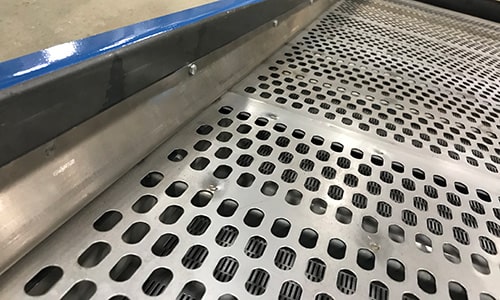
The screens do the heavy lifting – literally separating one size from another. These mesh panels or perforated plates come with precisely sized openings, and choosing the right aperture size and shape is crucial for getting the particle cut you need.
The drive mechanism is where the motion originates. Motors paired with eccentric weights or specialized oscillating drives create that vigorous shaking action. It needs to be powerful enough to move material efficiently but smooth enough to last for years.
Supporting everything is the frame, built tough to handle constant vibration and heavy loads day after day. Raw material enters through the hopper at the top, and different size fractions exit through separate discharge outlets – typically one for overs (material too large to pass through) and one for unders (material that made it through the screen).
Every component is engineered with longevity in mind. Our shaker screeners are built to run reliably for decades, not just years.
The Role of the Ball Agitation System
A common headache in screening operations is sticky or damp materials clogging up the mesh. When you need consistent flow, everything can grind to a halt as particles get wedged in the screen openings. This problem, called screen blinding, can kill your throughput.
A ball agitation system working quietly beneath the screen is the solution for this issue.
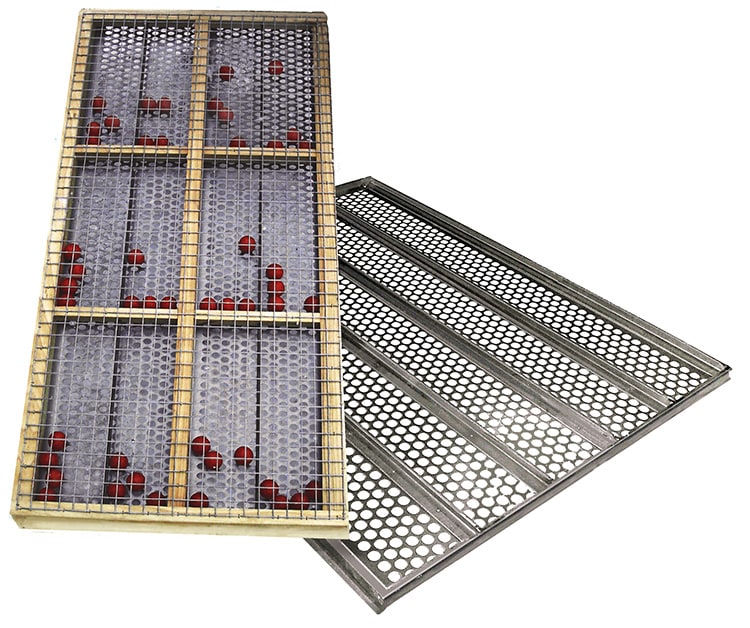
A layer of cleaning balls—made from materials like gum rubber, polyurethane, silicone, etc depending on your temperature requirements—bouncing around under the screen media. As your shaker screener vibrates, these balls constantly tap and impact the underside of the mesh, knocking loose any particles trying to get stuck.
This is especially helpful with those frustrating near-size particles that are almost small enough to pass through but tend to wedge themselves in the openings instead. The constant agitation keeps everything moving, maintains optimal screening efficiency, and helps with particle stratification. It’s one of those simple innovations that makes a world of difference when you’re dealing with difficult materials.
Available Deck Configurations
Every operation has unique needs, which is why deck configuration matters so much. We offer flexible options to match your specific separation requirements.
A single-deck setup is beautifully straightforward—material enters, and you get two fractions: overs and unders. It’s perfect for basic scalping operations where you’re removing large contaminants or need just one clean cut point.
Step up to a double-deck configuration and you’re creating three distinct size fractions in one pass. The top deck handles the coarser separation, and the bottom deck refines the unders from above into two additional sizes. This setup eliminates the need for a second screening step.
Our triple-deck systems are the most versatile, producing up to four different size fractions simultaneously. For complex applications requiring multiple precise cuts, this configuration maximizes efficiency dramatically.
Types of Shaker Screeners and Their Common Applications
The value of shaker screeners lies in their adaptability. Different materials and processing goals require different screening approaches, from fine flour to crushed limestone, making these machines essential across many industries.
Our American-made industrial processing equipment handles a remarkable range of dry granular materials. In agricultural products, these units handle products like grains like corn, wheat, and oats, plus seeds, beans, animal feed, and rice hulls. Getting these materials properly sized and cleaned isn’t just about quality—it’s about maximizing value from every bushel. We’ve written extensively about how this equipment transforms agricultural operations in our article on The Critical Role of Industrial Grain Screening Equipment in the Agriculture Industry. Our specialized grain cleaners have been doing exactly this for decades.
The minerals and aggregates sector relies heavily on precise screening for sand, crushed limestone, potash, and pumice. In plastics and recycling, separating different sizes of plastic pellets or flakes ensures quality control. And in food processing, sifting spices, nuts, or cereal demands product purity and consistency, adhering to standards like the FDA’s Current Good Manufacturing Practices (CGMPs).
Beyond these core industries, our screeners handle wood chips, biomass pellets, and a variety of other industrial materials that need reliable separation.
Motion Types in Shaker Screeners
The way a screen moves dramatically affects how well it processes different materials.
Horizontal reciprocating motion is our workhorse for dry granular materials. With its long stroke and slower speed, it creates a unique “dancing” effect that encourages rapid stratification. Particles bounce and shift, with the finer ones quickly finding their way through the mesh while larger ones travel across to their exit. This motion excels at high throughput and precision sizing, handling aperture ranges from about 1-½ inches down to 1600 microns.
Linear vibration offers a more direct, back-and-forth action that you can dial up or down in intensity. It’s versatile enough to handle many different applications, making it a solid all-around choice when you need flexibility.
Circular motion takes a gentler approach. Instead of vigorous back-and-forth action, it creates a spreading, swirling movement across the screen surface. This is perfect for very fine, lightweight, or delicate materials that need thorough separation without getting beaten up in the process.
Common Applications for a Shaker Screener
Walk through any of our customer facilities, and you’ll see shaker screeners handling an impressive variety of materials. We’ve processed everything from delicate spices to chunky crushed limestone, from tiny metal powders to bulky wood chips.
Our equipment regularly handles grains including corn, wheat, barley, and oats, along with spices that require gentle but thorough sifting. Sand and crushed limestone move through our screens by the ton. Various pellets—whether animal feed, biomass, or plastic—get sized and sorted with precision. Wood chips, nuts and seeds, and rice hulls all find their way through our screening systems.
We also work with more specialized materials like potash, flax seed, various meals, pet foods, salt, pumice, soybeans, and even metal powders. Whether your goal is cleaning, grading, or sifting, our screeners deliver the reliability you need day after day.
Small-Scale and Portable Options
Not every operation needs a machine the size of a small building. Sometimes you’re working with limited floor space, running pilot projects, or need screening capability in a specific area of your facility.
That’s why we design compact screening solutions custom to these situations. These smaller-scale screeners work beautifully for research facilities running test batches, operations where every square foot of floor space counts, or processes that require localized screening at specific production points.
While these compact units might not match the massive throughput of our largest industrial screeners, they’re built with the same engineering philosophy: durability, precision, and performance you can count on. If you’ve got a unique space constraint or a specific portability need, we’d love to hear about it. Contact S. Howes for custom solutions—honestly, we enjoy the challenge of solving tricky engineering puzzles.
Optimizing Your Screening Process: Features, Benefits, and Selection
The right shaker screener transforms your production line by boosting efficiency, improving product quality, and reducing waste. Modern shaker screeners achieve this with surprisingly low horsepower requirements and a low-maintenance design, saving you time and money. This means less time on maintenance and more time producing, keeping operational costs down. For a comprehensive look at what’s possible, explore our full range of screening equipment.
Key Features to Look for in a Shaker Screener
S.Howes builds shakers with heavy-duty construction. Some of our equipment has been running reliably for 75+ years—that’s not a typo. When you’re processing tons of abrasive material day in and day out, you need a frame and components that can take the punishment and keep on performing.
If you’re processing food products or dealing with fine, dusty materials, dust-free enclosed models aren’t just nice to have—they’re essential. These fully enclosed units prevent product contamination and keep your facility cleaner and safer. Your quality control team and your cleaning crew will both thank you.
Capacity matters, obviously. Our models handle anywhere from modest volumes up to 50 tons per hour, depending on configuration. With options ranging from single-deck simplicity to ten-deck complexity, and up to 800 square feet of screening area in a single machine, there’s a solution for virtually any throughput requirement.
Finally, custom discharge options might seem like a small detail, but they’re crucial for smooth integration with your existing conveying systems. The best screener in the world creates problems if the material can’t flow efficiently to the next process step.
Choosing the Right Mesh Size
Here’s where the rubber meets the road—or more accurately, where the particle meets the screen. Selecting the correct mesh size is the single most critical decision in optimizing your screening process. Get it right, and you’ll have precise separation and smooth operation. Get it wrong, and you’ll battle blinding, poor throughput, and quality issues.
Aperture size is your starting point. This is the actual opening in the screen through which particles pass. We’re talking about a huge range here—from 1.5 inches for coarse scalping operations down to 1,600 microns for precise powder separation. That’s the difference between screening crushed limestone and fine pharmaceutical powders.
The aperture you choose must match your material particle size and your separation goals. Are you removing rocks and trash from grain? That’s scalping—you need larger openings. Are you making a precise cut to ensure uniform pellet size? That requires careful matching of aperture to particle size. Are you removing fines from a product? You’ll need smaller openings that let the fines through while retaining the good stuff.
You’ll also need to decide between perforated plate and wire mesh. Wire mesh offers incredible versatility, with aperture sizes available across the entire spectrum, and it’s often more economical. Perforated plate, on the other hand, is the tank of screen media—more robust, more durable, ideal for heavier and more abrasive materials. It also offers specific open area percentages that can be engineered for your exact needs.
Don’t guess on mesh size. Our experts can help you nail down the ideal specifications for your material, and we often run tests in our product testing lab to confirm the choice before you commit. For applications requiring ultra-fine particle separation, you might also want to explore our power sifters, which take precision to another level.
Shaker Screeners: Application Suitability and Processing Goals
The effectiveness of a shaker screener comes from matching its motion type and configuration to specific materials and processing goals. Choosing the right screener is like choosing the right tool for a job—precision matters.
Shaker Screener Motion Types and Material Handling
The vibrating action of your screener isn’t just about making things move – it’s about making them move the right way for your specific material. Different materials have different personalities, if you will, and they respond best to different handling approaches.
When you’re dealing with topsoil screening, for instance, the ideal motion depends entirely on what’s mixed in with that soil. Standard topsoil with small rocks and organic matter does well with a gentle, consistent vibrating action. But if your topsoil is what we call “bony” – loaded with large wood chunks and rocks – you’ll want a more aggressive approach with a larger throw and slower RPM to handle those heavy contaminants effectively.
Sticky or clumpy materials present their own unique challenges. These troublemakers love to gum up screen surfaces and create headaches. That’s where aggressive vibratory action combined with our ball agitation systems really shines. The constant bouncing of those cleaning balls beneath the screen keeps things moving and prevents the dreaded screen blinding that can bring your operation to a crawl.
For operations handling large rocks and heavy debris, you need equipment built like a tank with motion to match. Robust construction paired with pronounced linear or horizontal reciprocating motion ensures that oversized material keeps moving across the deck without damaging the machine or creating bottlenecks.
On the opposite end of the spectrum, fine particle separation down to 300 microns requires finesse. This is where our long-stroke, slow-speed horizontal reciprocating motion really proves its worth. This carefully calibrated movement promotes maximum stratification, giving those tiny particles plenty of opportunity to find their way through the mesh while larger particles continue their journey across the screen.
And then there are wet or damp materials – the nemesis of many screening operations. These materials are notorious for causing screen plugging issues. While we can add screen heating transformers to some models to help combat moisture, the inherent motion characteristics and ball agitation of a well-designed shaker screener can dramatically reduce these problems without additional equipment.
The key takeaway is that material characteristics should drive equipment selection. Our process engineering team analyzes your material’s properties to recommend the optimal motion type and screener configuration, ensuring the solution is engineered for your real-world processing goals.
Maintenance and Troubleshooting for Optimal Performance
Even the toughest industrial equipment requires routine maintenance to perform at its best. Our shaker screeners are famously durable, with some units running for over 75 years, but they still benefit from routine inspection. This proactive approach is an insurance policy against costly downtime.
Catching small issues before they become big problems is key to avoiding major repairs. Let’s walk through the essentials for keeping your screening operation running smoothly.
Common Maintenance Requirements
Maintaining a shaker screener doesn’t require a PhD in mechanical engineering. It just takes consistency and attention to detail.
Start with bearing checks. The bearings in your drive mechanism are the unsung heroes of the operation. They’re constantly working, handling all that vibratory motion. Regular inspection for wear, proper lubrication, and any signs of overheating can prevent a catastrophic failure that shuts down your entire line. Our vibrator modules feature high-quality spherical roller bearings specifically designed for vibrating duty, which means they’re built to last. But they still need your attention.
Drive belt inspection should be a regular part of your routine. Check them regularly for proper tension, visible wear, and any cracks. A loose or worn belt doesn’t just reduce efficiency—it can cause inconsistent screening motion that affects your product quality. Proper belt tension ensures efficient power transfer and that consistent screening action your process depends on.
Screen panel replacement is inevitable. Screens are wear parts, plain and simple. They will eventually degrade or tear, especially if you’re processing abrasive materials. Regular inspection catches damage early, and timely replacement maintains your separation accuracy and throughput. We designed our quick-change screen systems specifically to make this process as painless as possible. Less downtime, more production.
Don’t forget about cleaning ball inspection if your screener has a ball agitation system. These balls work hard to prevent screen blinding, but they can wear down over time. Check that they’re intact, free from excessive wear, and made of the appropriate material for your operating temperature. Depending on your application, you might be using gum rubber, polyurethane, silicone, or even spring steel wire-wound balls. Each has its place, and keeping them in good condition is key to preventing clogging.
The beauty of our equipment is that it’s designed for low maintenance. That means fewer headaches for your maintenance team and more uptime for your operation.
Basic Troubleshooting Tips
Even with a solid maintenance routine, issues can pop up. Here’s how to tackle the most common problems.
Poor separation efficiency usually comes down to a few culprits. First, check your screen mesh. Is it the right size for your application? Has it worn down or gotten damaged, allowing oversized material to sneak through? Next, verify your material feed rate. An overloaded screener simply can’t do its job properly. The material needs time and space to stratify and separate. Finally, inspect your drive mechanism. Is the vibratory motion consistent and strong? Look for loose components or motor issues that might be affecting performance.
Excessive vibration or noise is your machine’s way of telling you something’s wrong. Start by inspecting the mounts. Damaged isolation springs or mounts can transfer excessive vibration to your floor and surrounding equipment. Check for imbalance—an unbalanced load on the screen or issues with the eccentric weights can cause unusual vibrations. And those bearings we talked about earlier? Unusual noises often mean they need lubrication or replacement.
Screen blinding or plugging is frustrating, but usually fixable. Review your material characteristics first. Is it damp, sticky, or loaded with near-size particles? Those are natural enemies of clean screening. If you have a ball agitation system, check that the cleaning balls are moving freely and actually impacting the screen. Sometimes you just need more balls in the deck. For particularly damp materials, a screen heating transformer might be the solution to prevent moisture-related blinding.
Structural cracks are serious business. While our heavy-duty construction minimizes this risk, any signs of cracking in the frame or supports need immediate attention from a qualified technician. Don’t wait on this one—small cracks become big problems fast.
When in doubt, check your equipment manual or give our technical support team a call. We’re here to help you keep your operation running smoothly, and we’ve seen just about every issue imaginable. Sometimes a quick conversation saves hours of troubleshooting.
Conclusion: Finding the Right Screening Solution for Your Operation
Choosing the right shaker screener is about finding a custom solution for your unique operational puzzle. Success depends on matching the machine’s configuration—from deck setup and motion type to screen design—to your specific material characteristics and throughput goals. Whether you need to process 50 tons per hour or achieve precise separation down to 300 microns, a custom approach is key.
At S. Howes, we use our product testing lab to analyze your material and engineer a system that delivers the results you need. Our commitment to heavy-duty American construction and thoughtful engineering is why some of our machines are still running after 75 years. The right screening equipment optimizes your process by reducing waste, improving product quality, and eliminating bottlenecks.
If you’re ready to find a durable, efficient screening solution for your agriculture, minerals, plastics, or food processing operation, our team is here to help. Ready to shake things up? Find the perfect shaker for your needs and let’s discuss what we can build together.